Arkansas’s Rural Maternal Health Crisis
“I was geriatric and worried that if I or the baby needed help, they would have to be med-flighted to Little Rock for NICU.”
Julianne Gasaway had to drive over an hour to receive the prenatal care she needed due to the lack of emergency care in Star City. If issues arose during her high-risk pregnancy, she needed established care with experts she trusted. Julianne is not alone. Approximately 45% of Arkansans live in rural areas. These rural communities have less access to care, worse health outcomes and more fragile local health systems than their urban neighbors. Nowhere is that gap wider than in maternity care.
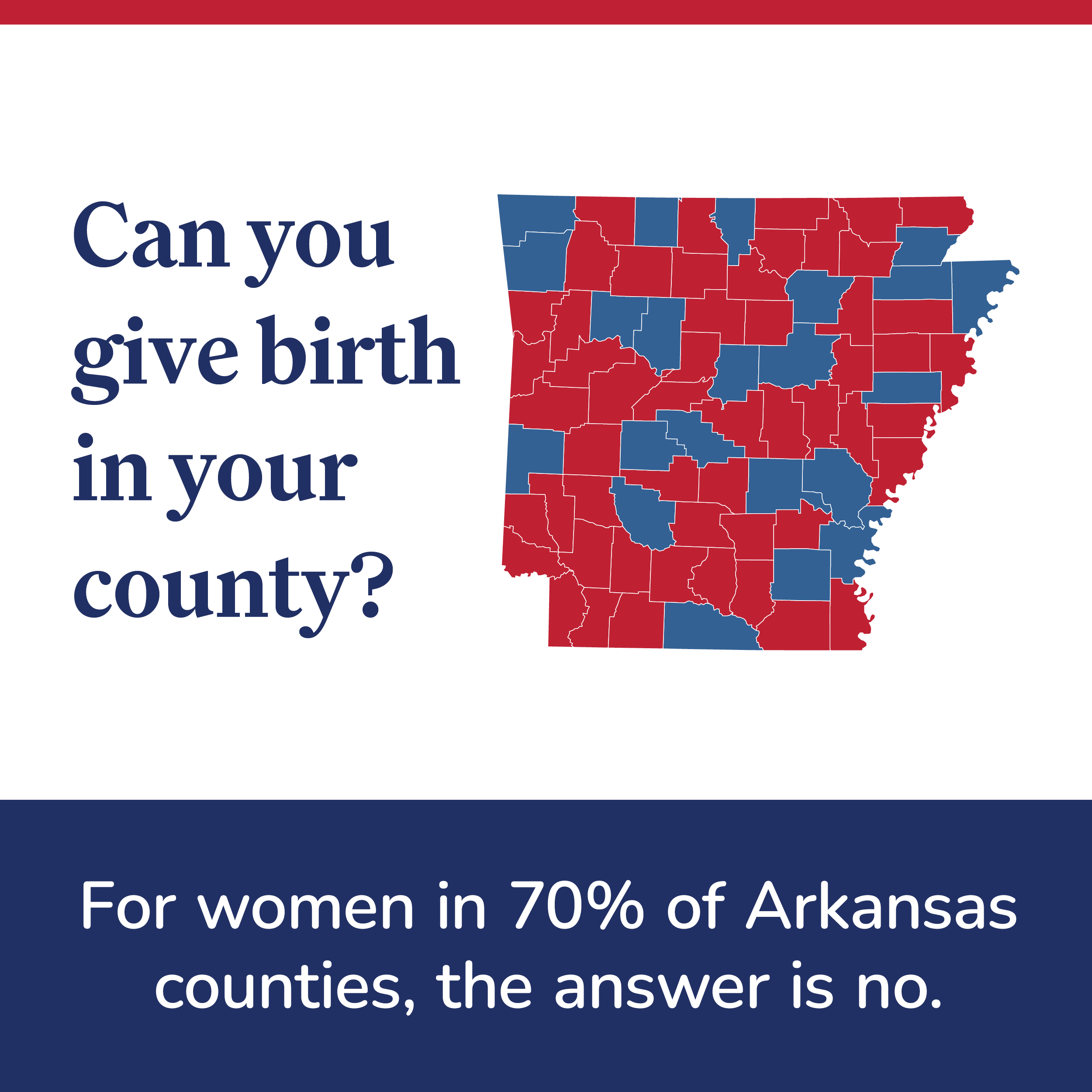
As of July 2026, there are only 30 hospitals providing labor and delivery services in Arkansas. And women in only 22 of the state’s 75 counties can give birth in a hospital located in their home county. Sixty percent of Arkansas’s rural hospitals do not offer labor and delivery services at all.
Since 2019, 10 hospitals have closed their obstetric units due to staffing shortages or finances. The most recent losses include Ouachita County Medical Center in Camden, which closed its Women's Center in January 2026, Baptist Health Fort Smith in April, and National Park Medical Center in Hot Springs, which announced in July that it would close at the end of August after the unexpected death of the hospital's only obstetrician.
The latest March of Dimes data underscores how widespread the access problem has become. More than half of Arkansas counties, 50.7%, are now classified as maternity care deserts, meaning they have no birthing hospital or birth center and obstetric clinician. Another 13.3% of counties have low or moderate access rather than full access. Arkansas has the sixth highest percentage of maternity care deserts in the country.
When a labor and delivery unit closes, the loss is not limited to delivery day. Prenatal visits, ultrasounds, specialist appointments and postpartum checkups all move farther away, and the appointments that get skipped are usually the ones that catch problems early.
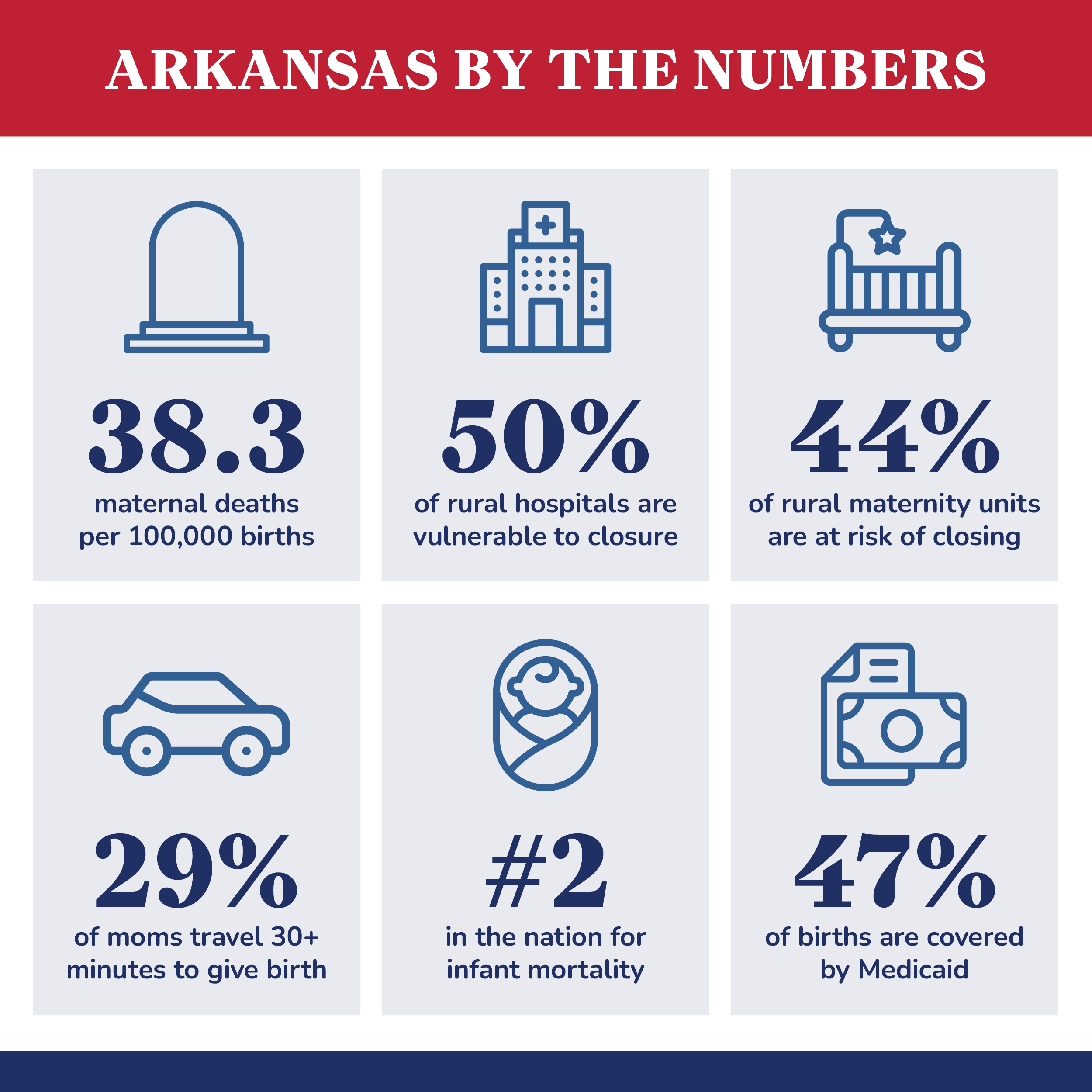
Arkansas by the Numbers:
Maternal mortality: 38.3 deaths per 100,000 live births from 2018 to 2022, one of the highest rates in the country. Between 2018 and 2022, 69 women in Arkansas died during pregnancy or within 42 days of delivery.
Hospitals at risk: 50% of Arkansas’s rural hospitals are vulnerable to closure –the highest percentage in the country.
Maternity units at risk: 44% of rural labor and delivery units still operating in Arkansas are at risk of closing and 27% of the state's rural labor and delivery units have closed since 2020.
Travel burden: The percentage of mothers traveling at least 30 minutes to give birth rose from 26% in 2019 to 29% in 2024, and the percentage of mothers traveling 60 minutes or more rose from 7% to 8%. County median drive times ranged from two minutes to 84. In Southeast Arkansas, the regional median climbed from 24 minutes to 39.
Infant mortality: Arkansas had the nation's second highest infant mortality rate in 2024 at 8.28 deaths per 1,000 births, only behind Mississippi at 9.65. Arkansas is one of only 16 states whose rate is significantly higher than the national rate.
Who pays: Medicaid financed 47% of Arkansas births, ranging from 29% in Benton County to 79% in Hempstead County. That makes state reimbursement policy the single biggest lever on whether a rural unit stays open.
Arkansas Compared to the Nation
The rural maternal health crisis in Arkansas is part of a national crisis. Only 41% of rural hospitals in the United States still offer labor and delivery services, and 146 rural hospitals have closed their units or announced they will do so by the end of this year – a 14% reduction since the end of 2020. The underlying pressure is financial. More than 40% of rural hospitals now operate at a loss, 417 are vulnerable to closure and 331 rural hospitals ended obstetric services between 2011 and 2024. The economics are simple. A maternity unit has to staff and equip itself around the clock, but hospitals are only paid when a delivery actually occurs, so low birth volumes turn an essential service into a permanent loss.
The Deep South carries the heaviest share of that burden. Alabama, Arkansas, Georgia, Louisiana, Mississippi, North Carolina and Tennessee all report pregnancy-related death statistics at least twice as high as the best performing states, a pattern researchers tie to a long regional history of underinvestment in maternal health. In Mississippi, 51% of counties are maternity care deserts and 24% of women live more than 30 minutes from a women’s hospital.
What’s being done?
Arkansas received $208.8 million for fiscal year 2026 through the federal government’s Rural Health Transformation Program. UAMS won a $4 million federal grant for HEART Moms, bringing maternal care closer to home in Southern Arkansas, and the legislature directed $2.5 million toward 22 residency slots in Crossett and El Dorado. In May, the Department of Health launched its first coordinated statewide campaign to help mothers find care near where they live.
Progress on paper is not the same as actual care. Doula and community health worker reimbursement, one of the most promising provisions in Act 140, has still not been implemented; the state blew past its December 31, 2025 deadline and remained months behind as of August 2026. Arkansas has repeatedly declined to extend postpartum Medicaid coverage from 60 days to 12 months – an option every other state has taken up in some form – with bills failing in both 2023 and 2025. That gap matters because roughly a third of maternal deaths happen in the year after birth, long after 60 days of coverage runs out.
Looking Ahead
Arkansas has some of the worst maternal outcomes in the country, the highest share of rural hospitals at risk of closing and a shrinking map of places where a woman can safely give birth. The next test comes with the 2027 session. Finishing what Act 140 started means implementing doula and community health worker coverage without further delay, extending postpartum Medicaid to a full 12 months and directing rural health transformation dollars toward keeping labor and delivery units open rather than simply managing their decline.